Leave Your Message

China Top Wire Conveyor Belt Suppliers for Global Buyers

Choosing reliable China wire conveyor belt suppliers requires more than comparing prices on a product page. Global buyers must examine material grades, mesh dimensions, belt width, edge finishing, and joining methods. A suitable Wire Covneyor Belt should match the product, oven temperature, conveyor speed, and cleaning process. Stainless steel belts may support demanding food, chemical, and heat-treatment applications. However, “stainless steel” alone proves little without a clear grade, test report, and production record.

Experienced suppliers usually provide drawings, sample sections, load guidance, and practical installation advice. Look for factories that explain spiral balance, rod diameter, pitch, and sprocket compatibility in simple terms. Ask for photographs of welding points and belt edges. Small details matter. A rough weld can damage products or shorten service life. Good suppliers also discuss packaging, replacement parts, delivery schedules, and after-sales support before receiving an order.

Still, supplier rankings should not be treated as permanent facts. Factory capacity, export experience, and quality systems can change. One buyer may need a fine mesh for drying snacks, while another requires a heavy-duty belt for sintering parts. Some catalog information may be incomplete or optimistic. That deserves careful checking. Request a production sample, verify measurements independently, and compare performance against your operating conditions. This guide introduces leading China suppliers through practical criteria, not promotional claims, helping buyers make a more confident and traceable sourcing decision.
China Top Wire Conveyor Belt Suppliers for Global Buyers

Wire Conveyor Belt Fundamentals: 0.5–3 mm Wire and 1–20 mm Mesh Openings

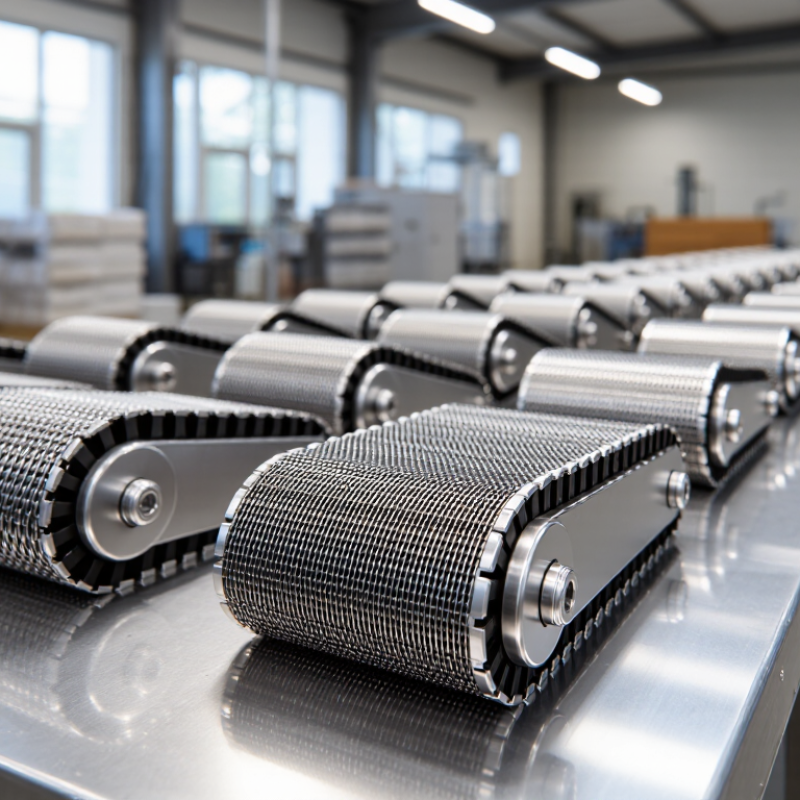
Wire conveyor belts rely on two measurements: wire diameter and mesh opening. Wire diameters from 0.5 to 3 mm balance flexibility, load capacity, and wear resistance. A 0.5 mm wire suits lightweight products and gentle handling. Thicker wire supports heavier loads and harsher processing conditions. Mesh openings from 1 to 20 mm control airflow, drainage, cooling, and product contact. Small openings protect delicate items. Large openings improve circulation and reduce belt weight. The correct choice depends on product size, temperature, load, speed, and cleaning method.

Tips: Request a physical sample before placing a large order. Measure the actual opening, wire diameter, belt width, and pitch. Ask for material certificates and load-test details. Check welded joints carefully. A polished surface may still hide weak connections. This step is often skipped.

A practical error is selecting mesh only by product size. Product movement, turning, and accumulation also matter. A 20 mm opening may appear efficient, yet small pieces can become trapped. Conversely, a 1 mm opening may restrict drainage and increase cleaning time. Consider sprocket compatibility and belt tracking during specification. Conveyor length and operating temperature can change tension requirements. The first design is rarely perfect. Pilot testing reveals problems that drawings miss. Reliable suppliers should explain tolerances clearly and provide consistent production records. Buyers should compare performance evidence, not only quoted price.
Material Selection: SS304, SS316, and Alloy Belts for Up to 1100°C

China Top Wire Conveyor Belt Suppliers for Global Buyers

Material selection determines whether a wire conveyor belt survives heat, scale, and repeated cycling. The 2024 World Stainless Association report recorded about 58.4 million tonnes of stainless steel production worldwide. This scale supports stable material availability, but availability should not replace engineering judgment. SS304 suits many oxidizing applications below extreme temperatures. SS316 adds molybdenum, improving resistance to chlorides and humid processing areas. Neither grade should be treated as a universal 1100°C solution.

For continuous exposure near 1100°C, heat-resistant alloy belts usually provide better oxidation strength and dimensional stability. ASM Handbook guidance shows that oxidation, carburization, and thermal fatigue can rapidly change high-temperature metal performance. Belt life also depends on wire diameter, mesh opening, furnace atmosphere, load weight, and cooling intervals. I would not select an alloy from temperature alone. That shortcut often looks efficient, then fails during thermal cycling.

Tips: Request the supplier’s temperature test data, chemical composition, and belt-load calculation. Check whether the stated 1100°C rating means continuous service or short exposure. Ask for evidence from similar furnace conditions. A tighter mesh may improve product support, but it can restrict airflow and increase heat retention. SS316 may sound safer, yet its added corrosion resistance does not automatically improve performance at extreme heat. The difficult part is balancing corrosion resistance, creep strength, flexibility, and replacement cost.

China Top Wire Conveyor Belt Suppliers for Global Buyers - Material Selection: SS304, SS316, and Alloy Belts for Up to 1100°C
Material Typical Chemical Composition Typical Recommended Continuous Operating Temperature Short-Term Temperature Capability Corrosion and Oxidation Performance Magnetic Behavior Relative Thermal Expansion Recommended Applications Selection Considerations
SS304 / AISI 304 Approximately 18% chromium and 8% nickel; balance primarily iron. Up to approximately 500–600°C Approximately 700–800°C, depending on load, atmosphere, belt design, and exposure time. Good general resistance to moisture, food acids, and many moderately corrosive environments. Oxidation resistance decreases as temperature and thermal cycling increase. Generally non-magnetic in the annealed condition; cold working can produce slight magnetism. Approximately 17.2 × 10⁻⁶/K at room-temperature ranges. Food processing, washing, drying, light heat treatment, general conveying, and applications with moderate temperature and corrosion requirements. Cost-effective general-purpose option
Not the preferred choice for prolonged operation near 1000°C.
SS316 / AISI 316 Approximately 16–18% chromium, 10–14% nickel, and 2–3% molybdenum. Up to approximately 500–600°C Approximately 700–800°C, subject to atmosphere, mechanical load, and thermal cycling. Better resistance than SS304 to chlorides, salt-containing environments, and many chemical process media. High-temperature oxidation resistance is not equivalent to a dedicated heat-resistant alloy. Generally non-magnetic in the annealed condition; cold working can produce slight magnetism. Approximately 16.0 × 10⁻⁶/K at room-temperature ranges. Marine or coastal processing, chemical handling, salt processing, pharmaceutical equipment, and hygienic applications exposed to chlorides. Best for chloride resistance
Choose a heat-resistant alloy rather than SS316 for continuous service close to 1000°C.
SS310S / AISI 310S Approximately 24–26% chromium and 19–22% nickel; low-carbon heat-resistant stainless steel. Approximately 900–1050°C Up to approximately 1100°C in suitable oxidizing atmospheres and with appropriate belt construction. Very good resistance to oxidation and high-temperature scaling compared with SS304 and SS316. Performance can be reduced by carburizing, reducing, or sulfur-rich atmospheres. Generally non-magnetic or only slightly magnetic when annealed; cold working may increase magnetism. Approximately 15.9 × 10⁻⁶/K at room-temperature ranges. Heat-treatment furnaces, sintering, brazing, ceramic firing, metal parts processing, and high-temperature drying. Preferred stainless option for high heat
Allow for thermal expansion and verify belt strength at operating temperature.
Alloy 600 / UNS N06600 Nickel-chromium alloy containing approximately 72% minimum nickel and 14–17% chromium. Approximately 900–1050°C Up to approximately 1100°C in suitable oxidizing service, subject to mechanical loading and atmosphere. Good resistance to oxidation and chloride-ion stress-corrosion cracking. Suitable for many furnace environments, although process chemistry must be reviewed before selection. Generally non-magnetic or weakly magnetic, depending on processing and service condition. Approximately 13.3 × 10⁻⁶/K at room-temperature ranges. Furnace fixtures, chemical heat-treatment equipment, thermal processing, and applications requiring nickel-chromium performance. Strong high-temperature corrosion option
Higher material cost than common stainless steels; confirm availability and fabrication requirements.
Alloy 601 / UNS N06601 Nickel-chromium alloy with approximately 58–63% nickel, 21–25% chromium, and aluminum additions. Approximately 950–1100°C Up to approximately 1150°C in selected oxidizing conditions, with service limits governed by load and belt configuration. Excellent resistance to oxidation and carburization in many high-temperature environments due to its protective alumina-forming behavior. Generally non-magnetic. Approximately 13.0 × 10⁻⁶/K at room-temperature ranges. Industrial furnaces, heat-treatment lines, carburizing equipment, radiant-tube environments, and high-temperature conveying systems. Recommended for demanding heat service
Suitable for applications approaching 1100°C when the furnace atmosphere and mechanical design are properly controlled.
Alloy 800H / UNS N08810 Nickel-iron-chromium alloy containing approximately 30–35% nickel and 19–23% chromium, with controlled carbon content. Approximately 900–1050°C Up to approximately 1100°C for suitable furnace applications and controlled loading conditions. Good resistance to oxidation, carburization, and nitridation in many elevated-temperature environments. High-temperature strength is generally superior to standard stainless steel. Usually weakly magnetic to non-magnetic, depending on thermal history. Approximately 14.4 × 10⁻⁶/K at room-temperature ranges. High-temperature furnace components, petrochemical processing, heat-treatment systems, and applications requiring creep resistance. High-temperature strength focused
Consider when load, creep resistance, and long-term furnace exposure are more important than initial material cost.
Technical note: Temperature figures are typical selection ranges for wire conveyor belts and are not guaranteed material limits. Actual service temperature depends on wire diameter, mesh type, belt width, belt tension, product load, support spacing, heating and cooling rates, furnace atmosphere, and thermal cycling. Continuous operation near 1100°C should generally be evaluated with a dedicated heat-resistant alloy and a complete belt design review. Thermal expansion, sag control, edge construction, and joining method should be confirmed before production.

Performance Metrics: Belt Width, Mesh Count, Tensile Strength, and Load Rating

When global buyers compare Chinese wire conveyor belt suppliers, four metrics deserve more attention than catalog photos. Belt width must match the conveyor frame, product footprint, and edge clearance. A 600 mm belt can fail operationally if guides leave no room for thermal movement. Measure the installed path, not only the nominal conveyor width. Mesh count describes opening density, but suppliers may calculate it differently. Request wire diameter, pitch, and opening size with every mesh figure. Do not guess.

Tensile strength indicates how much pulling force the belt can tolerate before permanent deformation. It is not the same as working load. Ask for tested tensile values, test direction, and recommended safety factors. For heavy trays, sharp components, or long spans, fatigue resistance also matters. A belt with high tensile strength may still sag when support spacing is excessive. Load rating should reflect product weight, belt mass, speed, and support arrangement. Use the supplier’s calculation, then verify it against site conditions. Numbers need context.

During factory evaluations, I check certificates, sample dimensions, weld consistency, and joint flexibility. A clean sample can hide variation across a ten-meter production run. Ask for dimensional tolerances and inspection records from the actual batch. One sourcing decision I would revise is accepting a single strength report. Independent retesting costs less than replacing a distorted belt. Suppliers that explain assumptions clearly are easier to trust. Each selection still deserves a trial fit under real temperature, moisture, and load conditions.

Representative engineering benchmarks for wire conveyor belts used in light-, medium-, and heavy-duty conveying. Belt width is measured in millimeters, mesh count as openings per 25.4 mm, tensile strength as N/mm of belt width, and load rating as kilograms per meter. Values are indicative market ranges and are not linked to any specific company or brand.

Supplier Verification: ISO 9001, ASTM A580, EN 10270, and Traceability

China’s wire conveyor belt supply base is broad, but supplier verification must go beyond factory photographs. The ISO Survey 2022 recorded about 1.26 million ISO 9001 certificates worldwide. That figure shows adoption, not automatic product consistency. Buyers should check the certificate scope, issuing body, expiry date, and covered production site.

ASTM A580 applies to stainless steel wire and wire products, while EN 10270 covers steel wire for mechanical springs. Neither standard should be treated as a universal conveyor belt specification. Ask suppliers to identify the exact wire grade, diameter tolerance, tensile strength, corrosion requirements, and test method. The weak point is often paperwork. Request recent mill certificates, not templates. Match each document with heat numbers, coil numbers, and shipment lots.

Traceability should work backward from a finished belt to raw wire, drawing records, welding controls, and final inspection. A 2024 World Steel Association report placed China’s crude steel output near 1.0 billion tonnes, indicating deep material capacity, but scale can also increase verification complexity. Sample testing by an independent laboratory is sensible for critical orders. It may expose small inconsistencies. That is useful. ISO 9001 supports controlled processes, yet it does not replace dimensional checks or fatigue testing. A careful buyer should record every deviation and require corrective-action evidence.

Global Purchasing Checklist: MOQ, Incoterms, Inspection, Packaging, and Lead Time

When evaluating China-based wire conveyor belt suppliers, global buyers should start with a written purchasing checklist. Ask for MOQ by belt width, mesh opening, wire diameter, and material grade. A low MOQ may carry a higher unit cost. Clarify whether samples count toward the first order. They often do not. Request drawings with tolerances, joint style, edge finish, and allowable belt length variation. These details reveal technical discipline better than polished catalog language.

Incoterms must match actual control. Under FOB, confirm the named port and loading responsibility. Under CIF, check insurance scope and destination charges before comparing quotations. Inspection should cover pitch, width, weld quality, flatness, and running direction. Use approved drawings and random measurements, not photographs alone. A pre-shipment report should record instruments, sampling size, defects, and corrective action. Third-party inspection can add cost, but it reduces uncertainty for large orders.

Packaging deserves equal attention. A belt packed wet or without edge protection can arrive distorted. Specify vapor barrier, rust preventive paper, wooden supports, labels, and roll dimensions. Ask how packaging survives crane handling and container movement. Lead time should separate production, inspection, packing, and shipping. Get a realistic date, not an optimistic promise. I would also request a delay procedure in writing. This checklist is useful, but not perfect; site conditions and seasonal capacity can change it. Recheck assumptions before approving payment.