Leave Your Message
Industrial Oven Belt is a critical component in continuous baking, drying, tempering, and heat-treatment lines. Its performance affects product consistency, energy use, hygiene, and unplanned downtime. According to MarketsandMarkets’ Conveyor Belt Market report, demand continues to grow across food processing, logistics, and industrial manufacturing. Grand View Research also identifies automation and higher production efficiency as major drivers for industrial oven investment.
The China Top 10 Industrial Oven Belt Manufacturers guide examines suppliers through practical criteria. These include temperature resistance, belt material, tensile strength, mesh opening, edge finishing, tracking stability, and delivery capability. Food-grade applications require closer attention to FDA, EU, or equivalent compliance documentation. A polished catalogue is not enough. Factory audits and application references matter.
R. Todd Swinderman, a recognized conveyor engineering specialist, has often emphasized a central principle: “Control the material, and you control the conveyor.” The same idea applies inside an oven. Uneven loading, poor tension, or weak cleaning procedures can shorten belt life quickly. This ranking is therefore a useful starting point, not an absolute verdict. Public information varies between manufacturers, and some technical claims remain difficult to verify independently. Buyers should request test data, operating temperatures, belt drawings, and installation records before making a final decision. Small details matter. A warped edge, one broken rod, or several millimetres of tracking error can disrupt an entire production shift.
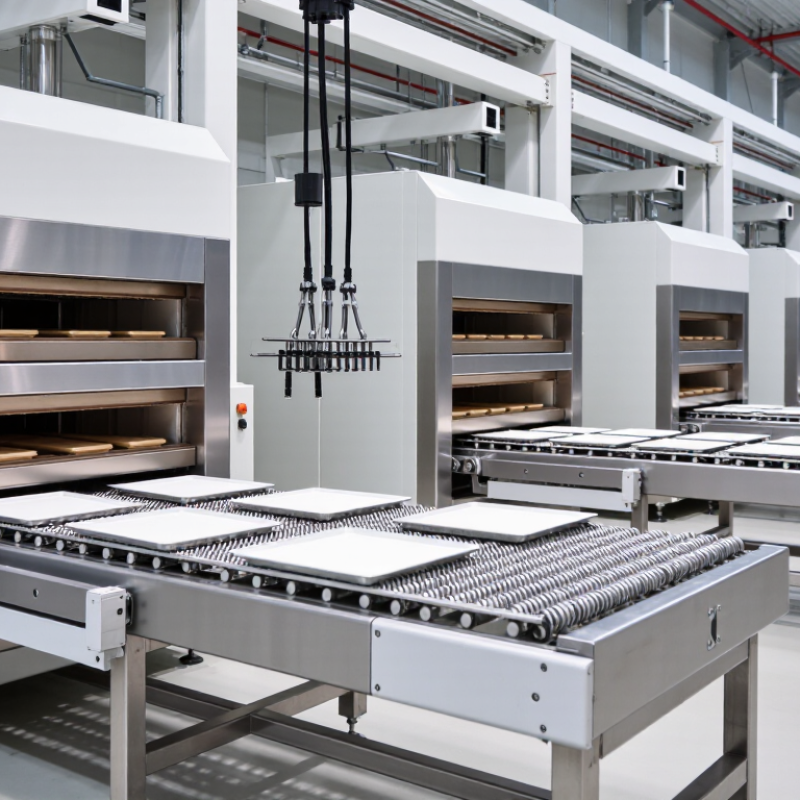
China Top 10 Industrial Oven Belt Manufacturers
Industrial Oven Belts: Definition, Structure, and Main Functions
An industrial oven belt is a continuous conveyor surface that carries products through heated processing zones. It must tolerate heat, load pressure, airflow, and repeated movement. In practical installations, belt selection depends on temperature, product size, oven length, and cleaning conditions. A belt that performs well in a dry bakery oven may fail in a damp coating line.
Typical structures include woven wire mesh, perforated plate, linked rods, and chain-driven assemblies. Stainless steel is widely used because it resists oxidation and supports hygienic cleaning. The belt may include sprockets, cross rods, side plates, and welded joints. Each part affects tracking. Small alignment errors can create edge wear, vibration, or product marks.
The main function is controlled product transport. It also influences heating uniformity, residence time, and air circulation around each item. Open mesh improves airflow, while tighter surfaces support small or fragile products. Maintenance teams should inspect tension, welds, sprocket engagement, and deposits. Do it regularly.
In my experience, excessive tension is a common mistake. It can damage bearings and shorten belt life. However, loose belts also cause unstable tracking. The correct setting requires observation during cold starts and full-temperature operation. Engineers should record actual belt speed and temperature, rather than trusting estimates. Even good designs need adjustment.
Industrial oven belt types, construction features, material options, and primary applications
| No. | Industrial Oven Belt Type | Definition and Basic Structure | Common Belt Material | Typical Design Temperature* | Main Functions | Typical Oven Applications |
|---|---|---|---|---|---|---|
| 1 | Balanced Weave Belt | Alternating right- and left-hand spiral wires are joined by crimped cross rods, creating a stable, flexible conveyor surface. | Stainless steel 304 or 316 | Approximately 400–600°C | Provides continuous conveying, good flexibility, and balanced tracking during heating and cooling. | Baking, drying, annealing, heat treatment, and food processing. |
| 2 | Compound Balanced Weave Belt | Uses several spiral wires and multiple cross rods in a compact pattern to increase strength and reduce openings. | Stainless steel 304, 316, or high-temperature alloy steel | Approximately 500–800°C | Supports heavier loads, improves product stability, and resists belt deformation in long furnace zones. | Ceramic firing, sintering, powder metallurgy, and high-load heat treatment. |
| 3 | Chain Edge Belt | A woven mesh is connected to roller chains or articulated edge links that transmit drive power from the sprockets. | Stainless steel or heat-resistant alloy steel | Approximately 300–700°C | Maintains positive tracking, handles substantial loads, and enables controlled belt speed. | Continuous ovens, coating lines, washing and drying systems, and heavy industrial furnaces. |
| 4 | Rod Network Belt | Straight or formed rods are connected by links, spirals, or crossbars to create a rigid open conveyor surface. | Stainless steel 304 or 316 | Approximately 350–600°C | Offers a firm carrying surface, accurate product positioning, and effective air circulation. | Food ovens, blanching, steaming, cooling, drying, and washing equipment. |
| 5 | Flat Wire Belt | Flat metal strips are linked with rods to form a smooth, relatively closed surface with low product marking. | Stainless steel 304 or 316 | Approximately 250–500°C | Reduces product indentation, supports small items, and provides a stable surface for uniform processing. | Biscuit baking, bread production, snack processing, and product drying. |
| 6 | Perforated Plate Belt | A continuous or assembled metal plate contains punched or drilled openings for airflow and drainage. | Stainless steel 304, 316, or carbon steel for controlled atmospheres | Approximately 200–500°C | Carries small or unstable parts, limits product loss, and allows hot air or liquid to pass through. | Small-parts drying, coating, deburring, washing, and thermal processing. |
| 7 | Spiral Link Belt | Spiral wires are interlinked and joined by cross rods, producing a lightweight mesh suitable for moderate loads. | Stainless steel 304 or 316 | Approximately 250–500°C | Promotes heat transfer, reduces belt weight, and supports economical conveying in medium-temperature ovens. | Food baking, snack drying, lightweight product curing, and cooling conveyors. |
| 8 | High-Temperature Alloy Belt | A woven or linked belt made from nickel-containing or other heat-resistant alloys for demanding thermal environments. | Nickel alloy or specialized heat-resistant alloy steel | Approximately 700–1,100°C | Resists oxidation, creep, scaling, and strength loss at elevated temperatures. | Metal heat treatment, brazing, sintering, ceramic processing, and controlled-atmosphere furnaces. |
| 9 | Polymer-Coated Conveyor Belt | A fabric or metal-supported belt covered with a heat-resistant polymer layer to provide a non-stick or smooth conveying surface. | Glass-fiber fabric with PTFE or silicone coating | Approximately 150–260°C | Provides release performance, low friction, easy cleaning, and reduced product adhesion. | Food baking, non-stick drying, composite processing, laminating, and coating ovens. |
| 10 | Modular Plastic Belt | Injection-molded modules are connected with hinge rods to create a sprocket-driven belt with replaceable sections. | Heat-resistant engineering polymer | Approximately 80–150°C | Provides easy maintenance, positive drive, flexible layout options, and simple belt-section replacement. | Low-temperature drying, food processing, cooling, washing, and packaging-line ovens. |
*Temperature values are typical design ranges for selected belt materials and constructions. Actual allowable temperature depends on belt tension, speed, atmosphere, load, heating method, and the specific material grade.