Leave Your Message
What Is the Best Conveyor Belt Transport System? The answer depends on the material, route, operating conditions, and cost of downtime. A belt moving dry aggregate through a dusty transfer point faces different demands from one carrying packaged goods across a distribution floor. The right choice begins with the actual job—not a brochure’s maximum-speed claim.
Industry guidance helps frame that decision. The Conveyor Equipment Manufacturers Association’s Belt Conveyors for Bulk Materials, Seventh Edition, covers design factors such as capacity, belt tension, loading, and material behavior. MHI’s 2024 Annual Industry Report provides broader data on supply-chain technology adoption and investment priorities. Together, these sources underline a practical point: equipment selection should account for the whole operating system, not just the conveyor itself. Consider the belt, drives, idlers, loading zones, controls, maintenance access, and the consequences of a stoppage. Small details matter. A poorly aligned belt can spill material beneath a transfer point; an awkwardly placed service platform can make routine inspection harder.
A named expert’s exact quotation cannot be responsibly included without a verifiable source. Inventing a quote would weaken the reliability of this comparison. The useful question remains: which Conveyor Belt Transport system fits the site’s load, layout, safety needs, and lifetime operating costs? A careful answer weighs measurable requirements against real working conditions. It may also acknowledge uncertainty: early estimates rarely capture every maintenance burden. That is worth checking before purchase.
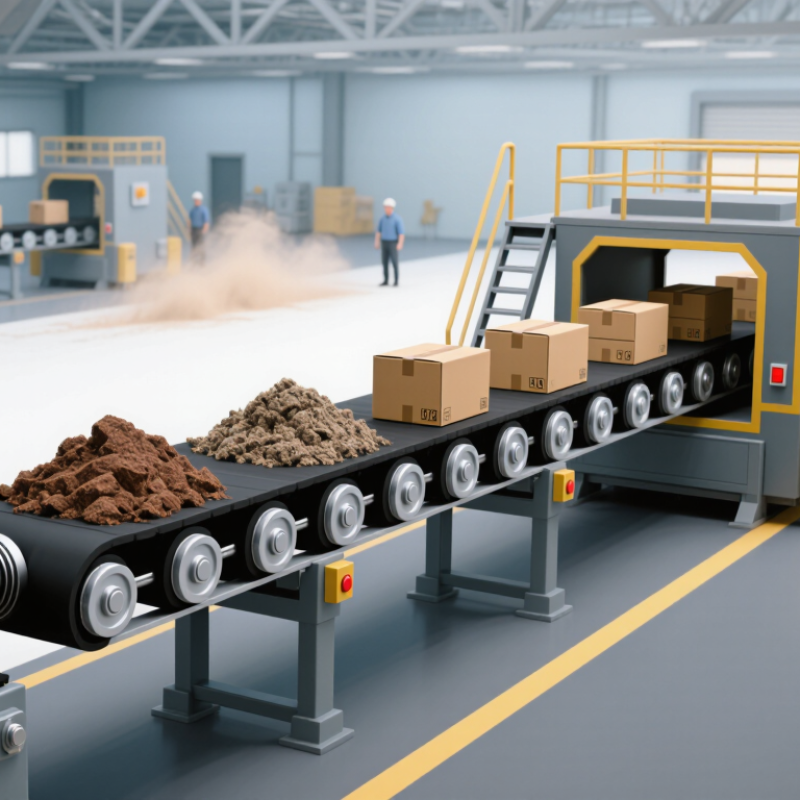
A conveyor belt moves material by carrying it on a continuous loop. A motor turns the drive pulley, pulling the belt across rollers called idlers. At the loading point, a chute guides material onto the belt. Skirt boards help contain it. The belt then travels along a route, often through a plant or between processing stages, before a head pulley releases the load into a hopper or onto another conveyor.
Capacity depends on more than belt width. CEMA’s Belt Conveyors for Bulk Materials, 7th edition, calculates capacity using belt speed, the material’s cross-sectional load, and its bulk density. For example, doubling belt speed could roughly double theoretical throughput if the load profile and material flow remain unchanged. Real systems rarely behave so neatly. Wet fines may stick; large lumps can bounce at transfer points. Small details matter.
Operators use idlers to support the belt and pulleys to guide and drive it. Sensors can monitor belt drift, speed, or loading, helping crews spot trouble early. At transfer points, careful chute design reduces spillage and uneven loading. A belt that runs smoothly when empty may still track poorly under a full load. That assumption is easy to miss. Regular inspections of belt edges, rollers, and loading zones help reveal wear before it disrupts material flow.
| Conveyor System | How It Moves Materials | Typical Applications | Indicative Throughput | Typical Belt Speed | Route and Incline Suitability | Main Advantages | Key Considerations |
|---|---|---|---|---|---|---|---|
| Troughed belt conveyor | A flat belt runs over angled idlers that form a trough, helping contain loose bulk material. | Mining, quarries, ports, power generation, and bulk-material handling. | About 100–10,000+ tonnes per hour, depending on belt width, speed, material, and loading conditions. | About 1–6 m/s in many bulk-handling installations. | Well suited to long, continuous routes. Inclines are commonly around 10–18° for free-flowing bulk materials; the practical limit depends on the material and belt surface. | High capacity, efficient continuous transport, and adaptable layouts over long distances. | Spillage, dust, and material rollback can occur if the belt, loading points, or incline are not designed for the material. |
| Flat-belt conveyor | Materials rest directly on a flat belt supported by a bed or rollers. | Packages, cartons, components, and unit loads in warehouses, manufacturing, and distribution. | Often about 50–1,000 items per minute for unit handling; bulk tonnage varies widely by design. | About 0.3–3 m/s in many handling applications. | Best for level or gently inclined routes. Steeper movement may require cleats, side guides, or another conveyor type. | Simple, versatile, and suitable for transporting individual items or evenly distributed loads. | Loose bulk material may spill, and smooth belts provide limited grip on inclined routes. |
| Pipe belt conveyor | Idlers roll the belt into a closed tube around the material during transport. | Bulk materials on routes passing near buildings, roads, waterways, or environmentally sensitive areas. | Commonly about 100–3,000 tonnes per hour, subject to belt size, speed, and material characteristics. | About 1–5 m/s in many installations. | Can follow curved alignments and handle moderate inclines; achievable distance and incline depend on the route and material. | Enclosed carrying route helps reduce dust and spillage and can accommodate horizontal curves. | Requires careful belt design and alignment; transfer points and maintenance access still need consideration. |
| Cleated belt conveyor | Raised cleats or flights on the belt help hold material in place as it travels uphill. | Granules, agricultural products, packaged goods, and bulk materials that need incline assistance. | Often about 10–500 tonnes per hour for bulk handling; capacity varies substantially with cleat design and material. | About 0.5–3 m/s in many applications. | Suitable for moderate inclines, often around 20–35° depending on material and cleat height. | Reduces rollback on inclines and can move material through compact layouts. | Cleat spacing and height must match the material; cleats can make cleaning and belt maintenance more involved. |
| Sidewall belt conveyor | Flexible corrugated sidewalls and cross-cleats form compartments that retain material on steep climbs. | Bulk materials where a small footprint or a steep lift is needed, such as plants and transfer stations. | About 20–2,000 tonnes per hour in a broad range of designs. | About 0.5–3 m/s in many installations. | Can convey at steep angles, including near-vertical lifts in purpose-designed systems. | Moves material upward in a compact footprint and can reduce the need for multiple transfer stages. | Higher design complexity; belt, sidewalls, and cleats must be selected for the material, loading, and service conditions. |
| Portable or mobile belt conveyor | A belt mounted on a movable frame transports material between loading and discharge points. | Temporary stockpiling, construction, truck loading, agricultural handling, and changing work areas. | Often about 50–1,500 tonnes per hour, depending on equipment size and material. | About 1–4 m/s in many bulk-handling applications. | Useful for changing or temporary routes; elevation and reach depend on frame length and adjustment range. | Can be repositioned as work areas or stockpiles change, reducing the need for a fixed route. | Capacity and stability depend on setup, ground conditions, loading method, and operating configuration. |
Selection note: There is no single best conveyor system for every operation. The right choice depends on material properties, required throughput, route length, incline, available space, environmental controls, and maintenance needs. Figures shown are indicative ranges, not guaranteed performance specifications.